Catalog
Internal Clearances – Definition
| INTERNAL CLEARANCES | |
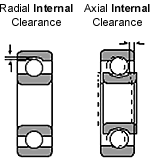 Radial Internal Clearance Suffixes used by SKF, Link-Belt and FAG are equivalent to our suffixes. The Internal Clearance of a bearing is the total distance through which one ring can move relative to the other ring under zero load. This movement in a radial direction is called Radial Internal Clearance and the movement in an axial direction, Axial Internal Clearance.The Radial Internal Clearance of a bearing before mounting is generally greater than when placed in service. The reduction in clearance arises from the expansion of the inner ring or contraction of the outer ring when they are mounted with an interference fit and from the relative heat expansion of the bearing at the operating temperature. Radial Internal Clearance Suffixes used by SKF, Link-Belt and FAG are equivalent to our suffixes. The Internal Clearance of a bearing is the total distance through which one ring can move relative to the other ring under zero load. This movement in a radial direction is called Radial Internal Clearance and the movement in an axial direction, Axial Internal Clearance.The Radial Internal Clearance of a bearing before mounting is generally greater than when placed in service. The reduction in clearance arises from the expansion of the inner ring or contraction of the outer ring when they are mounted with an interference fit and from the relative heat expansion of the bearing at the operating temperature.
The Internal Clearance of a Ball bearing should approach zero when it is mounted and running at its operating temperature. However, for Cylindrical, Tapered and Spherical Roller bearings some Radial Internal Clearance should generally be retained under normal operating conditions. This does not apply, however, when a very rigid bearing arrangement is required, in other words, for machine tool spindles. The standard Internal Radial Clearance values have been established to provide the optimum operating bearing clearance for those applications where normal fits and operating conditions apply. For other conditions, where both outer and inner rings are mounted with an interference fit, bearings with Radial Internal Clearance other than STANDARD should be selected. In such cases the net clearance remaining after mounting should be checked. Suffixes C/1 through C/5 are used to designate bearings having other than STANDARD clearance as follows: C/1 - Internal Clearance is smaller than C/2. The following Tables indicate the values for the various Internal Clearance groups which conform to the International Standards Organization (ISO) and The Anti-Friction Bearing Manufacturers Association (AFBMA) standards. These values apply to bearings prior to mounting and under zero load. |
|